


Novasign Studio | Industrial Biotech · Precision Fermentation · Cultured Food
Lower your production cost to a competitive level, faster
The product you are developing already exists in the market, made by chemical synthesis, plant extraction, animal-derived production, or an established fermentation route, and viability is determined entirely by how efficiently you can produce what others already supply.
Novasign Studio helps industrial biotech, precision fermentation, and cultured food teams reduce iteration cycles, identify cost-critical process variables, and make confident scale-up decisions, turning campaign history and process knowledge into clear, actionable decisions tied to your production economics.
Start with one cost question. Build a workflow. Make every run count.
THE CHALLENGE
The overhead that keeps industrial biotech teams from moving faster on cost
The challenge is rarely a shortage of data, campaign history, or technical expertise. The challenge is that the production cost target is set externally. It is set by a chemical synthesis route, an extraction process, or an established bio-based producer that has had years or decades to optimize, and closing that gap requires faster, better-justified process decisions than most teams are currently structured to make.
The cost benchmark is fixed by a competing technology
The production cost your process must reach to be commercially viable is not set by your development timeline. It is set by the technology that already supplies the market: chemical synthesis, extraction from natural sources, animal-derived production, or a fermentation process that has been running at industrial scale for years. Matching or undercutting that benchmark requires a systematic way to evaluate, optimize, and justify process decisions, and to translate an innovative biological or process approach into a production cost that competes.
Process economics only close at scale, and scale-up carries real uncertainty
The production cost targets that make a bio-based product viable require pilot or commercial-scale operation. How oxygen transfer, substrate gradients, mixing, and shear change with scale can be described by engineering correlations, but what those physical changes mean for cell metabolism, productivity, and product quality is considerably harder to predict. That gap is where scale-up risk lives, and it only becomes visible when the engineering run does not perform as expected.
The cost-critical process variables are hard to identify from campaign history alone
Energy, raw materials, media composition, aeration strategy, and feeding profile all contribute to production cost in ways that differ by product and scale. The challenge is that teams naturally focus experimental effort on what they believe drives cost most at the scale they currently operate, which may not reflect where the largest leverage actually sits at pilot or production scale. Without structured data processing and process modeling, the variables that genuinely drive cost of goods remain difficult to separate from noise, and the same process questions get answered repeatedly rather than built upon.
Process knowledge and modeling capability exist but do not reach the whole team
Where process models have been built, they typically live with one person and require specialist support to run. The broader team makes decisions based on experience and prior campaign outcomes, with limited ability to test the production cost impact of a process change before committing to an experimental run. External consultants can deliver useful outputs, but the models and workflows built during an engagement rarely transfer into something the team can run, adapt, and extend independently.
The result is iterative experimentation that is slower and more expensive than the competitive economics of this sector can sustain.
HOW NOVASIGN STUDIO HELPS
One connected workflow. From campaign data to production cost decisions.
Novasign Studio introduces a structured workflow layer across your development process.
Planning → Data processing → Process modeling → Decision support
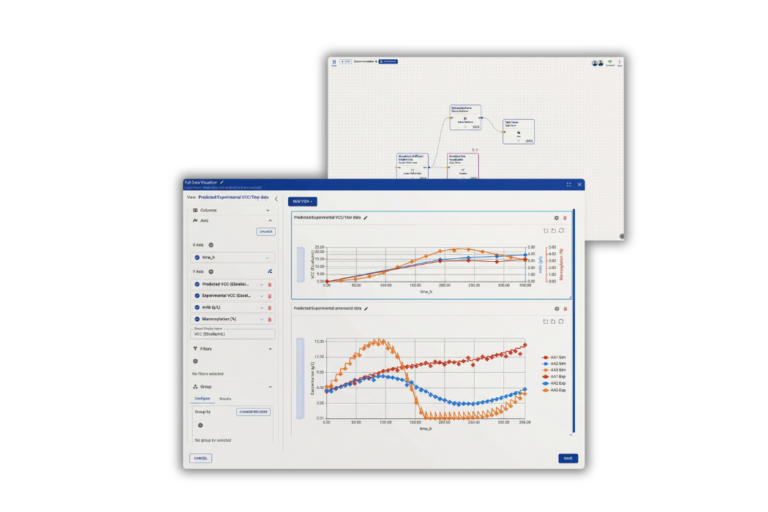
Novasign Studio gives each step a structured home, open to extension where you need it. It does not replace your existing models, scripts, or data infrastructure; it makes them reusable, reproducible, and shareable across your organization. Each step is designed to fit how process teams already work, not to require a new way of working.
1
Plan
Design smarter experiments around the specific decision you need to make, from screening to model-based Design of Experiments.
2
Process data
Consolidate campaign data from instruments such as bioreactors and PAT sensors, and from data systems such as LIMS and historian, into reproducible, comparable datasets your whole team can work from.
3
Model
Build process models from your data and process knowledge, explainable, auditable, and tailored to the program at hand.
4
Simulate
Run in-silico scenarios to test operating strategies, de-risk scale-up, and evaluate trade-offs before committing to lab or engineering runs.
5
Decide and reuse
Generate clear, explainable outputs tied to your production cost targets, built upon over time and applicable across products, not rebuilt from scratch.
USE CASES
Where Novasign Studio fits in industrial biotech, precision fermentation, and cultured food
From early-stage feasibility through pilot and commercial scale-up, across fermentation platforms, host organisms, and downstream unit operations.
Production cost decision support
Once a model is established, the focus shifts to identifying which process variables have the largest leverage on production economics: yield, productivity, media composition, feeding strategy, aeration, and agitation each contribute in ways that differ by product and scale. Novasign connects process conditions directly to cost-of-goods outcomes, so experimental effort is directed toward the runs that move the cost equation rather than those that are simply convenient to execute.
Media and feed optimization
Model-guided media development reduces the number of experiments required to identify optimal feed concentrations, carbon sources, and nutrient profiles. Time-resolved models reveal the dynamic relationship between feeding behavior, nutrient uptake, and metabolic response, capturing what endpoint-only DoE misses. For precision fermentation and cultured food teams in early development stages, where defined media with expensive components can represent a dominant share of production cost, this is often the highest-return starting point.
Scale-up risk reduction
Scenario-based simulation lets the model predict what process performance will look like at pilot or production scale before engineering runs happen. Those runs are used to validate expectations, not to explore them. Where bioreactor geometry matters, CFD-derived parameters such as kLa, mixing time, shear rate, and power per volume are integrated directly into the process model, adding a quantified basis to scale-up predictions and capturing how physical changes at scale translate into biological response. Novasign Studio supports direct import from small-scale systems including AMBR and Eppendorf systems out of the box, so the path from small-scale screening to scale-up model is as short as possible.
Process knowledge that reaches the whole team
Process knowledge built for one product or campaign does not have to stay locked to the person who developed it. Novasign Studio captures the data processing steps, model structure, and decision logic behind a process result in a reusable workflow. When the next campaign or product starts, the team builds from an established baseline rather than from scratch, and the capability is available to every team member, not only to the original author.
Continuous manufacturing support
For teams moving toward continuous fermentation or integrated upstream and downstream processes, Novasign’s connected workflow supports coupling of unit operations. Demonstrated in the ECOnti consortium: a 30-day continuous run with digital twin-controlled column switching achieved 32% reduced operational costs, 39% lower facility footprint, and 45% energy savings compared to batch processing.
WHO THIS IS FOR
Who Novasign Studio supports in industrial biotech
Studio supports both day-to-day process execution and longer-term capability building, depending on where your team is starting from.
Reduce Cost of Goods for your products
Reduce iteration cycles, improve scale-up confidence, and reach viable operating points faster. Structured decision support connects your campaign data directly to your cost targets.
Turn complex process data into clear recommendations
Reproducible data pipelines, PAT-informed analysis, and scenario testing turn your campaign history into clear next-step recommendations, without rebuilding analysis from scratch every time.
Build team ownership, not tool dependency
Transparent workflow steps, training, and decision support that your scientists and operators understand and control. When Novasign leaves, the workflow stays.
WHY NOVASIGN STUDIO
What makes Novasign Studio the right fit for industrial biotech
1
Titer matters. Production cost is what wins.
In industrial biotech, the process that survives is the one with the lowest cost per gram at scale. Novasign’s models connect process conditions to the individual cost contributors: media and substrate, energy, aeration, and agitation, making each contribution visible by source so experimental effort goes toward the variables that actually move the economics.
02
Explainable from input to decision
Every modeling assumption, preprocessing step, and scenario comparison is visible and auditable. Your team can understand why a recommendation was made, and challenge it if the biology does not match. No black box, no dependency on Novasign to interpret results.
03
Consultancy-led start, team-owned outcomes
We begin with a guided feasibility. Novasign experts build the first workflow alongside your team, using your process data. Training and handover ensure your scientists and operators can run, adapt, and extend the workflow independently. The goal is capability transfer, not ongoing dependency.
04
Scale-up confidence before the expensive run
CFD-integrated hybrid models allow prediction of large-scale process behavior from small-scale data. Test operating windows, identify risk factors, and compare reactor geometries before committing to pilot or production-scale runs that cost orders of magnitude more.
PROOF
Proof that the approach is practical
See how structured data, comparable runs, and explainable recommendations can help teams identify a stronger operating point and move toward lower process cost.
Arkeon
5× titer improvement and continuous scale-up
Novasign supported Arkeon’s continuous fermentation process, achieving a 5-fold titer improvement through model-based DoE and scaling the continuous process from lab to pilot scale. Results currently under second revision at Nature.
Bisy GmbH
50%+ timeline reduction
Bisy GmbH reduced development timelines by more than 50% in an initial proof-of-concept study, using Novasign to translate process potential into new products and processes.
Internal showcase
Up to 70% experimental effort reduction
In an internal platform showcase across fermentation applications, Novasign workflows reduced experimental effort by 35 to 70% compared to conventional DoE approaches, demonstrated across E. coli, yeast, microalgae, and mammalian platforms.
ECOnti consortium
30-day continuous manufacturing
A 30-day continuous upstream and downstream process with digital twin-controlled chromatography and filtration achieved 32% reduced operational costs, 39% lower facility footprint, and 45% energy savings compared to batch processing.
How Novasign Studio compares
Novasign Studio is built for teams that need a practical, end-to-end workflow, covering everything from experimental data to modeling, simulation, and better process decisions.
Novasign Studio vs. internal scripts and local models
Move from person-dependent analyses to reusable, structured workflows your whole team can review, apply, and build on.
Novasign Studio vs. cloud-based bioprocess modeling platforms
Keep full flexibility in deployment, workflows, and model integration, including fully on-premises setups where data governance requires it.
Novasign Studio vs. standalone solutions
Use Novasign Studio as an integrated workflow platform. Selected components can also be white-labeled for organizations who want to embed the capability under their own brand.
Novasign Studio vs. pure mechanistic or pure ML modeling tools
Supports mechanistic, data-driven, and hybrid models across multiple unit operations. Choose the modeling approach that fits your data availability, and connect unit operations so changes propagate through the full workflow.
GETTING STARTED
Start with one cost question. See what your data can do.
The right starting point if you want concrete results. We work with you on a scoped proof of concept using your existing campaign data, so the outcome is relevant to your specific process and cost challenge from the first step.
WHAT PROCESS LOOKS LIKE
- Scoping call: Define one process challenge and one cost-down or scale-up decision to focus on
- Data review: Novasign reviews your existing data and defines what the proof of concept can produce, at no cost to this point
- Proof of concept: We build and run the workflow in Novasign Studio together with you
- Results and next steps: Clear outputs, a defined scope, and your decision on how to proceed
- Review outcomes, recommended next steps, and adoption path
- Transition to internal use with training and workflow handover
WHAT YOU RECIEVE
- Workflow built on your actual process data
- Digital twin for the relevant process decision
- Scenario comparison tied to your unit economics
- Recommended next experiments or operating conditions
- Training and handover so your team runs it independently going forward
FAQ
Questions industrial biotech teams ask first
What do I need to get started?
Less than you might expect. We begin with a short scoping call to understand your process and goals, with no data required upfront. If you want to move into a proof of concept, structured or semi-structured process data is sufficient: CSV, historian exports, LIMS, or XLSX. We assess data suitability together before any commitment. Most teams start with a retrospective study of existing campaign data from a single fermentation process.
How many experiments do I need?
There is no fixed number, and that is precisely the point. Novasign Studio works with whatever data you already have, however limited, and uses it to reduce risk and identify the smallest set of experiments needed to reach your specific process goal. Rather than defining a standard DoE upfront, Novasign Studio builds on your existing process knowledge, trains a model, and identifies which experiments will be most informative next. The result is a targeted, goal-driven experimental plan, not a predefined one.
Do I need a dedicated modeling or data science team?
No. Studio is designed for process scientists, fermentation engineers, and lab scientists as the primary users. All core features are accessible through no-code graphical interfaces, with no programming required. Teams with data science capability can also use Studio: custom Python code integrates directly, letting data scientists bring their own models and scripts into a shared Novasign Studio environment so colleagues can use them immediately, without any coding on their end.
Can I run Novasign Studio on-premises?
Yes. Novasign Studio can be deployed fully on-premises, giving your team complete control over your data and infrastructure. Cloud-based deployment is also available. This flexibility matters for teams with strict IP protection requirements around proprietary process data or internal IT policies.
Who owns the models and workflows we build?
You do. All models, data processing workflows, and derived insights you generate in Novasign Studio belong to your organization. Novasign retains ownership of the platform's native components only. Your data is never used by Novasign for any other purpose.
Can this handle continuous fermentation or precision fermentation platforms?
Yes. Novasign has direct experience with continuous fermentation processes, microalgae, precision fermentation, and cultured food platforms, alongside traditional industrial microbial and mammalian cell culture. The modeling framework adapts to the specific biology rather than requiring a pre-built template.
Can I start modeling before my data infrastructure is fully set up?
Yes. You do not need centralized data, a standardized data infrastructure, or any automation system before getting value from modeling. Most teams start by using models to support process decisions, reducing uncertainty and identifying the most informative next experiment before committing to a run. Automation is a natural next step, and when the time comes, models built in Novasign Studio can feed directly into automated workflows.
How transparent is Novasign Studio?
Fully transparent. Some software tools deliver results you have to trust without being able to investigate how they were derived; Novasign Studio is designed to be the opposite. Every data processing step, model training decision, simulation, and process recommendation is traceable and explainable. Your team can inspect and document the complete path from raw data to output, which is essential when building the internal case for a process decision or justifying a production cost improvement to stakeholders.
How quickly will I see results?
The first tangible results, including structured data, comparable datasets, and initial visualizations, are typically delivered within one to four weeks. Predictive models and reduction in experimental effort follow within one to three months, depending on data availability and project scope. Teams starting with a proof of concept typically see clear, decision-relevant outputs within the first project.
NEXT STEP
Start with one cost-down decision
Choose one decision tied to your production economics: feed strategy, harvest point, downstream optimization, or scale-up conditions. Find out whether your existing campaign data can support faster, better decisions.
No transformation program. No software commitment before value is proven. One decision, one guided proof of concept, one clear outcome.