HomeBioprocessAutonomous Continuous Biomanufacturing: Closing the Gap Between Process Development and Production
Autonomous Continuous Biomanufacturing: Closing the Gap Between Process Development and Production
Continuous biomanufacturing has long been considered one of the most promising approaches to increase productivity, reduce facility footprint, and enable more sustainable bioprocessing. Yet despite decades of research and significant technological progress, fully integrated continuous manufacturing platforms remain rare in industrial biotechnology.
Two fundamental challenges explain this gap
Genetic stability must be ensured over extended process durations, as production strains will accumulate mutations during long continuous cultivations that most likely impact productivity or product quality.
At the same time, deep process understanding is required to control the dynamic interactions between upstream cultivation, cell retention, and downstream purification that must remain stable over a long manufacturing period.
enGenes Biotech
Microbial expression systems and continuous upstream processing
BOKU
Process development and downstream processing
Tosoh Bioscience
Continuous Chromatography
Qubicon
Automation and process control infrastructure
SimVantage
Computational fluid dynamics (CFD) modeling
Novasign
Digital Twins for Optimization and Control
Together, these partners developed an integrated production chain for recombinant protein A production in E. coli, that combines upstream cultivation, cell retention and filtration, and downstream chromatography purification.
The objective of the project was not only to demonstrate technical feasibility but to establish a platform capable of autonomous operation while maintaining stable product quality.
Digital Twins for Integrated Process Control
Within the project, Novasign developed hybrid process models representing the entire continuous production chain. These models allow predictive monitoring and control of the integrated platform and connect experimental data, process knowledge, and automation into a unified digital twin environment.
Hybrid mechanistic and data-driven models were developed for four central unit operations of the continuous platform:
Seed bioreactor
Production bioreactor
Filtration crossflow system
Chromatography control
These models were connected in Novasign Studio, forming a digital representation of the entire production process. The digital twin was executed in real time within the Qubicon automation environment, enabling interaction between process data, predictive models, and automated control decisions.
The main control challenge was maintaining constant product quality at the process outlet despite variable upstream conditions such as fluctuations in biomass concentration, pH, or conductivity. Model-based predictions allowed the system to anticipate disturbances and dynamically adapt downstream operations.
A critical example was the timing of chromatography column switching. Because upstream process conditions and filtration performance can vary over time, the chromatography step must adapt continuously. The digital twin enabled prediction of loading conditions and triggered column switching at the correct time, ensuring stable purification performance throughout the continuous run.
Connecting Physical and Digital Process Layers
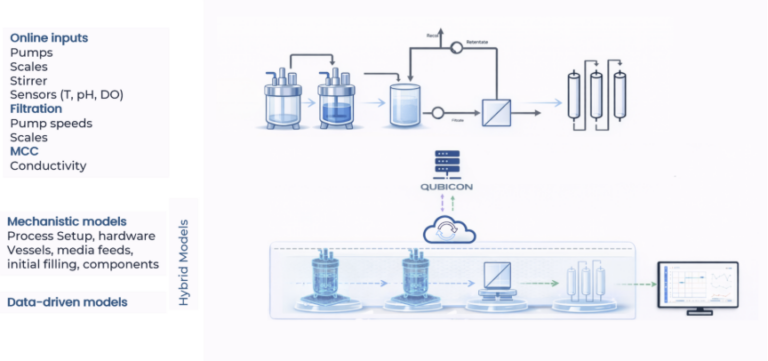
The architecture developed within the project connects the physical production environment with a virtual digital twin layer. Real-time signals from pumps, sensors, filtration systems, and chromatography units are transmitted to the automation infrastructure, where hybrid models simulate the process behavior and provide predictive inputs for control.
Figure 1. Interaction between the physical process layer and the digital twin layer. The upper section represents the integrated continuous production system including bioreactors, filtration, and chromatography. Real-time process signals such as pump speeds, sensor data (temperature, pH, dissolved oxygen), filtration parameters, and conductivity are transferred to the automation layer. The lower section represents the virtual digital twin environment where hybrid mechanistic and data-driven models simulate the process chain and provide predictive input for monitoring and control.
The Result
Toward Autonomous Continuous Manufacturing
The integrated platform demonstrated how continuous upstream and downstream processing can significantly improve process efficiency compared with conventional batch production.
Continuous cultivation allows cells to remain in their productive state for extended periods, enabling up to 5x Increase of Space time yield.
At the same time, the tight integration of cultivation, filtration, and chromatography reduces the need for large intermediate storage volumes and batch buffers.
As a result, the entire production system can be operated with a several-fold smaller facility footprint, enabling compact manufacturing setups and more efficient resource utilization. Continuous processes can therefore reduce energy and water consumption while increasing productivity.
A key technical achievement of the ECOnti platform was thestable coupling of upstream and downstream operations under varying process conditions. Variations in upstream parameters such as biomass concentration, pH, or conductivity were compensated through model-based control. The digital twin predicted column loading behavior and triggered chromatography column switching at the correct time, ensuring stable purification performance and consistent product quality at the process outlet.
A demonstration of the integrated platform and its real-time control architecture is available in the project video on LinkedIn